A Loan allows you to use money now and pay it back later. This Detailed Guide explains what is Loan, their Types, Benefits and Key Terms in simple words.
What is a Loan?
A loan is money that an Individual or Business borrows from a Bank, Financial Institution or Lender and promises to repay on time. The borrower pays back the Principal amount along with an additional amount called Interest.
Important Key Terms
- Principal: Actual amount of money you borrow from a Bank or Financial Institution.
- Interest: The extra money you pay on the Principal amount.
- Interest Rate: The percentage charged as Interest on the Principal.
- EMI (Equated Monthly Instalment): This is a fixed amount that you pay every month.
- Loan Tenure: The time given to you to repay the Loan (like 1 year, 5 year).
- Secured Loans: This is a type of Loan where you have to pledge something (like Property, Gold) as Security.
- Unsecured Loans: This is a type of Loan where you don’t have to pledge something as a Security.
- Credit/CIBIL Score: A number that shows how good you are at repaying Loans.
- Eligibility: The terms and conditions of the Bank or Lender.
- Lender: The Bank, Company or Financial Institution that gives you the Loan.
- Borrower: The Person or Business that takes the Loan.
- Collateral: The Asset given as Security.
- Prepayment: Early payment, either in full or in part.
- Foreclosure: Paying off the loan before the full tenure. Some Banks charge a fee for this.
- Outstanding Amount: The remaining amount you still need to pay.
- Down Payment: Money that you pay from your own pocket before buying something (like Car, Property).
- Processing Fee: A small amount charged by a Bank or Lender for processing your Loan.
- Late Payment Fee: Extra charge if you miss or delay EMI.
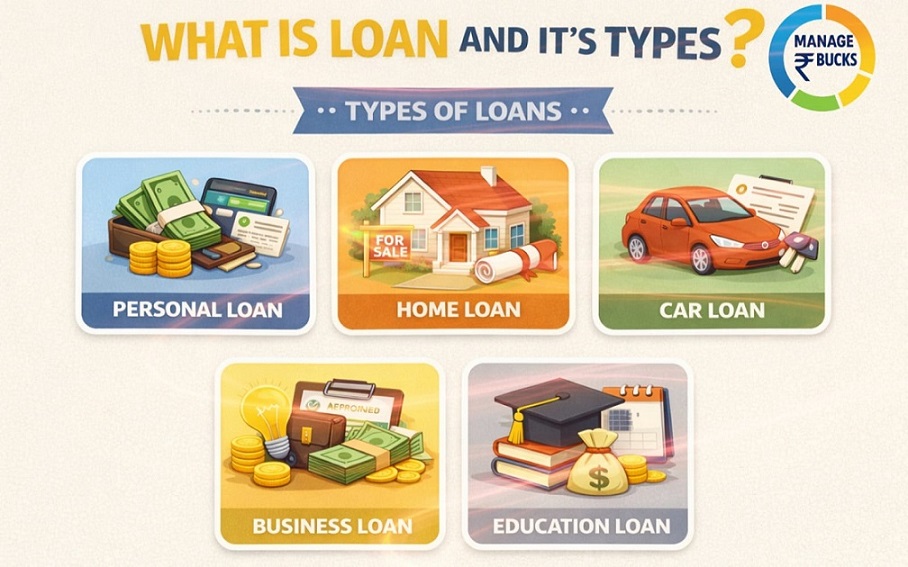
Types of Loans
Loans are mainly of two types – Secured Loans and Unsecured Loans. Let’s talk about them in detail.
Secured Loans
These are Loans where you have to pledge some of your assets or property to the Bank or Lender as collateral. The main types of Secured Loans are as follows:
1. Home Loan
This Loan is taken to buy or build a house. It is available for a long period at low interest rates.
2. Gold Loan
You can borrow money by keeping Gold as security. The interest rate is low and the approval process is fast.
3. Vehicle Loan
It’s used to purchase Cars, Bikes or other Vehicles. The interest rate is low, and the Vehicle remains collateralized.
4. Loan against Property
This is taken by keeping your House or Land as security. This is generally taken for large expenses or business needs.
5. Loan against Securities
If you have Shares, Mutual Funds and Bonds and you need money, then instead of selling them, you can take a Loan by mortgaging them to a Bank or Financial Institutes.
6. Loan against Fixed Deposits
You can avail a loan against Fixed Deposits from Banks or Financial institutions without breaking it.
7. Loan against Insurance
This allows you to borrow money against your Insurance Policy. The interest rate is low, and the Loan is based on the current value of your Policy.
8. Education Loan (Big Amount)
If the amount is large, you may need to pledge Property or FD. This is usually used for Higher Studies.
Unsecured Loans
These are loans that do not require any collateral; they are granted based on your Job or Income. These have higher Interest Rates compared to Secured Loans. The main types of Unsecured Loans are as follows:
1. Personal Loan
This is taken for personal use such as Medical Expenses, Travel, Emergencies etc. They don’t require collateral, but the Interest Rates are higher.
2. Education Loan (Small Amount)
It is taken for studies in India or abroad. No security is required for small study needs.
3. Business Loan
It is taken to start or grow a small Business. No security is required for small Business needs.
4. Mudra Loan
These are Government-backed Loans for small Businesses. No collateral is required.
5. Credit Cards Loans
These Loans are taken against the Credit Card limit, based on the Credit Card.
6. Instant/App-Based Loans
These are offered through Apps and Online Platforms. They are easy to get, but the Interest Rates are high.
7. Salaried Advance Loans
Short-term Loans those are given to Salaried Employees before they receive their Salary. These Loans are later adjusted against their Salary.
8. Festival Loans
These are given during Festivals for a short term. They are used for Shopping and Celebrations.
Benefits/Advantages of Loans
A Loan provides you financial support when your savings are not sufficient. Here are some of its main benefits:
- Help in Big Expenses – Helps you with large Expenses such as a House, Car or Education without having to pay the entire amount at once.
- Instant Money when you need – You can get Money instantly for Emergencies such as Medical Expenses, Home Repairs, Weddings, etc.
- Helps in achieving Goals – You don’t need to save money for years and wait to achieve your Goals. This helps you achieve your Goals early.
- Easy Monthly Installments – You don’t need to pay a big amount all at once; you can repay in Easy Monthly Installments.
- Helps in Business Growth – If you depend on savings to grow your Business, it will take time. With a Loan, you can achieve faster Growth.
- Improves Credit Score – Paying your EMIs on time builds a good Credit Score, which helps you get cheaper and Big Loans in the future.
- Special Benefits on some Loans – Some Home and Education Loans offer Tax Benefits, Subsidies or other special Scheme Benefits provided by the Government.
- No need to sell the Assets – No need to sell Gold, Property or Savings to cover Large Expenses or unexpected financial needs.
Eligibility for Loans
Lenders or Banks check a few basic things before giving you a Loan, which are as follows:
- Age – Usually above 18 years (According to the terms and conditions).
- Income – You should have a regular income from your Job or Business.
- Employment or Business – Your Job or Business should be stable.
- Credit Score – A good Credit Score means you pay your Loans on time. The higher your Credit Score, the greater your chances of approval.
- Active Loans – If you already have too many Active Loans, your Loan application may be rejected or the loan amount may be reduced.
- Security (For Secured Loans) – For Secured Loans, you will need to provide collateral such as Property, FD and Gold Assets.
- Documents – Basic documents are required, such as Aadhaar card, PAN card, Income Proof, Address Proof and Bank Statement etc.
Mistakes to Avoid
When applying for a loan, you need to be aware of certain mistakes, otherwise you might face difficulties in getting approval, such as:
- Borrowing more than necessary – First, decide how much you need, and then Borrow accordingly. Borrowing more than you need will result in higher repayments and interest charges.
- Don’t think about EMI and the Budget – Many people focus only on getting a loan somehow and don’t pay attention to the EMI and budget, considering how much they can comfortably afford to pay monthly. Before applying, you should check with an EMI Calculator to see what monthly installment amount would be right for you.
- Not checking Interest Rates and Charges – You need to carefully check the Interest Rate, Processing fees, Late Payment Charges, Foreclosure Charges and any other hidden charges and compare them with other lenders.
- Not reading the Terms and Conditions properly – You should always read the terms and conditions carefully before signing. The terms and conditions contain information about all the Charges, Auto-Debit details, Prepayment Rules etc., which could otherwise surprise you later.
- Ignoring your Credit Score – A good credit score helps you get Loan approval easily and at a lower interest rate. You need to keep an eye on your Credit Score to ensure there are no pending dues or errors.
- Taking too many Loans at once – Having too many loans at once increases your financial pressure. You should try to avoid having multiple Loans.
- Not paying EMI’s on time – Missing or delaying your EMI payments can result in penalties and damage your credit score. Try setting up Auto-Debit/Reminders to ensure you don’t miss any EMI payments.