
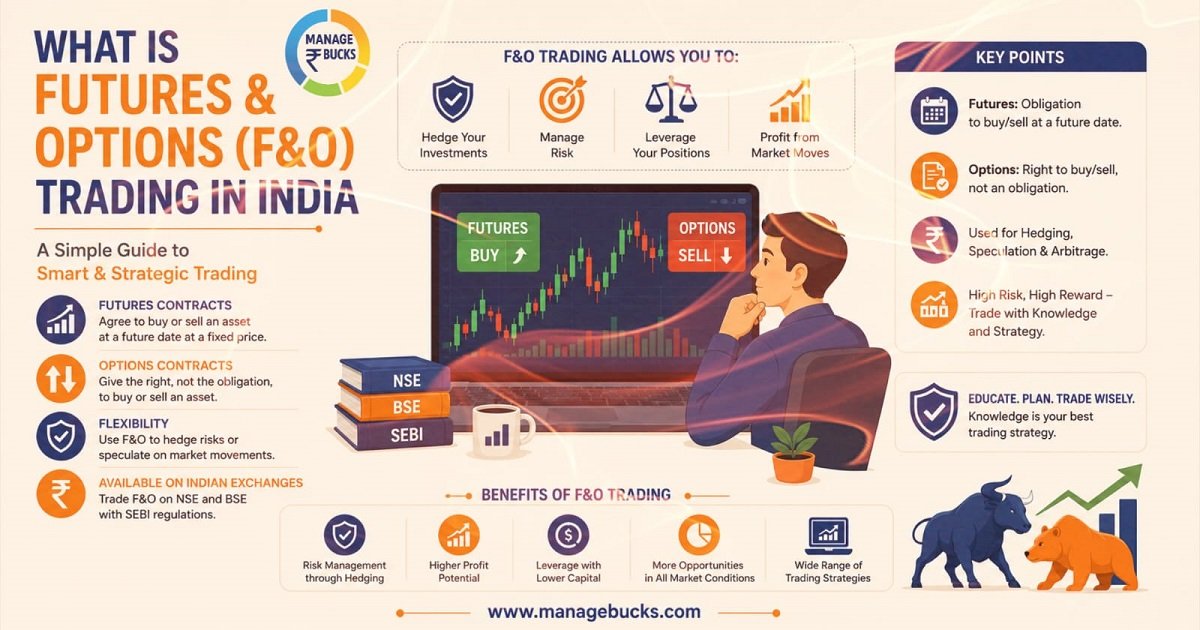
If you are a beginner in the Stock Market or are considering trading, you have likely heard the terms ‘Futures’ and ‘Options’ (F&O). You may have also heard people talk about making significant profits through Futures and Options trading. However, many newcomers also incur financial losses because they start trading without understanding how Futures and Options work.
In this guide designed for beginners, we will explain Futures and Options trading in India using simple language.
Important: F&O trading involves high risk. Before getting started, it is crucial to thoroughly understand the rules, margin requirements, lot sizes, and the potential for loss. This article is for informational purposes only and should not be considered financial advice.
What Is F&O Trading?
F&O stands for:
F = Futures
O = Options
These are both types of derivative contracts that allow you to bet on the future price of something—usually a stock, an index like the Nifty 50 or Bank Nifty, or a commodity like gold or crude oil.
To put it simply, when you trade in F&O, you’re not buying the actual stock or gold. You’re buying a contract that’s based on the price of that stock or gold. That’s why they’re called “derivatives”—because their value is determined by something else.
For example, if you buy a Nifty futures contract, its price will depend on the movement of the Nifty index.
What Is Futures Trading?
A ‘future’ is a contract or agreement between a buyer and a seller to buy or sell something at a predetermined price on a specific future date.
For example, suppose Nifty is trading at ₹25,000 today, and you believe its price will rise to ₹25,200 within a month. You therefore buy a Nifty futures contract at today’s price. If the price actually rises to ₹25,200, you make a profit. Conversely, if the price falls to ₹24,800, you incur a loss.
The key point is that your profit or loss fluctuates based on changes in the price of the underlying asset, and you are obligated to settle the deal on the expiry date, regardless of whether the price movement works in your favor or not.
What Is Options Trading?
An option is a contract that gives you the right, but not the obligation to buy or sell something at a predetermined price before a certain date. In exchange for this right, you pay a premium to the seller.
There are two main types of Options:
- Call Option (CE)
- Put Option (PE)
What is Call Option (CE)?
A call option gives the buyer the right to purchase an asset at a predetermined price in the future. If you believe the price will rise, you can buy it.
For Example:
Suppose NIFTY is trading at 25,000. If you believe its price will rise before expiry, you buy a NIFTY 25,100 CE (Call Option) by paying a small fee known as a ‘premium’ (e.g., ₹100). If NIFTY surges to 25,200, you will make a good profit. However, if NIFTY falls or stays below 25,100, you are not obligated to exercise the option; your loss is limited solely to the ₹100 premium you paid.
What is Put Option (PE)?
Buying a put option gives the holder the right to sell an asset at a predetermined price in the future. If you believe the price will go down, you can buy it.
For Example:
Suppose NIFTY is trading at ₹25,000, but some bad news emerges and you think the price will fall, you buy a NIFTY 24,900 PE (strike price = ₹24,900) by paying a premium of ₹100, and NIFTY drops to ₹24,800, you make a good profit. Conversely, if NIFTY rises, you exit the trade and lose only your initial premium of ₹100.
Futures Vs Options: What is Difference?
| Basis | Futures | Options |
| Nature | Buyer and seller have contractual obligations | Option buyer has a right, not an obligation |
| Payment | A margin has to be deposited. | Buyer pays premium |
| Profit/Loss | Profit/loss can be large | Option buyer’s loss is generally limited to premium paid |
| Margin | Requires Margin | Option buyer pays premium; option sellers generally require margin |
| Risk | High Risk | Limited risk for Option Buyer, High risk for Option Seller |
Why do people trade in F&O?
Generally, people enter F&O trading for two reasons:
Hedging – F&O can be used to reduce or manage the risk associated with existing investments. For example, a jewelry company might use ‘gold futures’ to lock in the price of gold, thereby avoiding losses in the event of a sudden drop in gold prices.
Speculation – Most retail traders use F&O in an attempt to make quick profits by betting on price movements, often utilizing leverage to do so.
What is Leverage, and why is it Risky?
Leverage allows you to control a large position with a smaller amount of capital. You simply put up a small margin—perhaps 10–20% of the total value—and this is what is known as leverage.
While this sounds appealing, there is a significant downside: leverage amplifies both profits and losses. Just as it can multiply your gains, it can escalate your losses just as rapidly—sometimes so quickly that you don’t even have time to react.
Important Key Terms
- Strike Price: The predetermined price at which an option buyer acquires the right to buy or sell in the future.
- Lot Size: F&O contracts are traded in fixed lot sizes rather than as single units. Since this changes periodically, always check the current lot size before placing a trade.
- Premium: The price you pay to purchase an options contract.
- Expiry Date: The date on which the contract expires; most Indian F&O contracts expire on a weekly or monthly basis.
- Margin: The amount you are required to deposit with your broker to take a futures position.
- Open Interest (OI): The total number of outstanding contracts, often used to gauge market sentiment.
Why do new traders lose money in F&O?
Many newcomers enter the F&O market after seeing screenshots of huge profits on social media, often overlooking the losses involved. Here are some common reasons why new traders lose money:
- Trading without understanding the basics: Most beginners start options trading without grasping the fundamentals (such as premiums, strike prices, and expiry).
- Using excessive leverage: Traders can take positions that are much larger than their available capital. A single adverse market move can lead to significant losses.
- Trying to recover losses quickly: After losing money, some traders increase their position size in an attempt to recoup their losses. This can worsen the situation.
- Overtrading: Placing too many trades due to market volatility can lead to unnecessary losses and high transaction costs.
- Following Telegram or advisory tips: A common mistake is blindly relying on tips from Telegram channels or advisory services. There is no guarantee of profit in the stock market.
- Ignoring risk management: Even a sound trading strategy can result in losing trades; therefore, risk management is crucial.
Is F&O Trading Good for Beginners?
If you are completely new to the stock market, there is no need to start directly with F&O. First, understand the following:
- How the stock market works
- What shares are
- How the NSE and BSE operate
- Market orders and limit orders
- Basic technical and fundamental analysis
- Risk management
- How brokerage and taxes work
If you are just starting out with investing, it is wiser to get comfortable with standard equity investments, mutual funds, or SIPs. Save F&O for later—and only after you have learned it properly.
F&O trading is a powerful tool used by professional traders and large institutions; however, without a proper understanding, it carries a significant risk of rapid financial loss. Understanding the distinction between futures and options, familiarizing yourself with terms like ‘margin’ and ‘premium,’ and being aware of the actual loss figures faced by retail investors can help you make better decisions.
Disclaimer: This article is for informational and educational purposes only and should not be considered investment advice. Please conduct your own research and consider consulting a qualified financial professional before making any trading or investment decisions.