If you are a salaried employee or run a small business, you have likely heard the term ESIC at some point. But do you know what ESIC is, why the deduction is made, what it covers, and how to use it?
In this article, we will explain in simple language what ESIC means, who is eligible for it, what benefits you can avail, and how to claim those benefits.
What is ESIC?
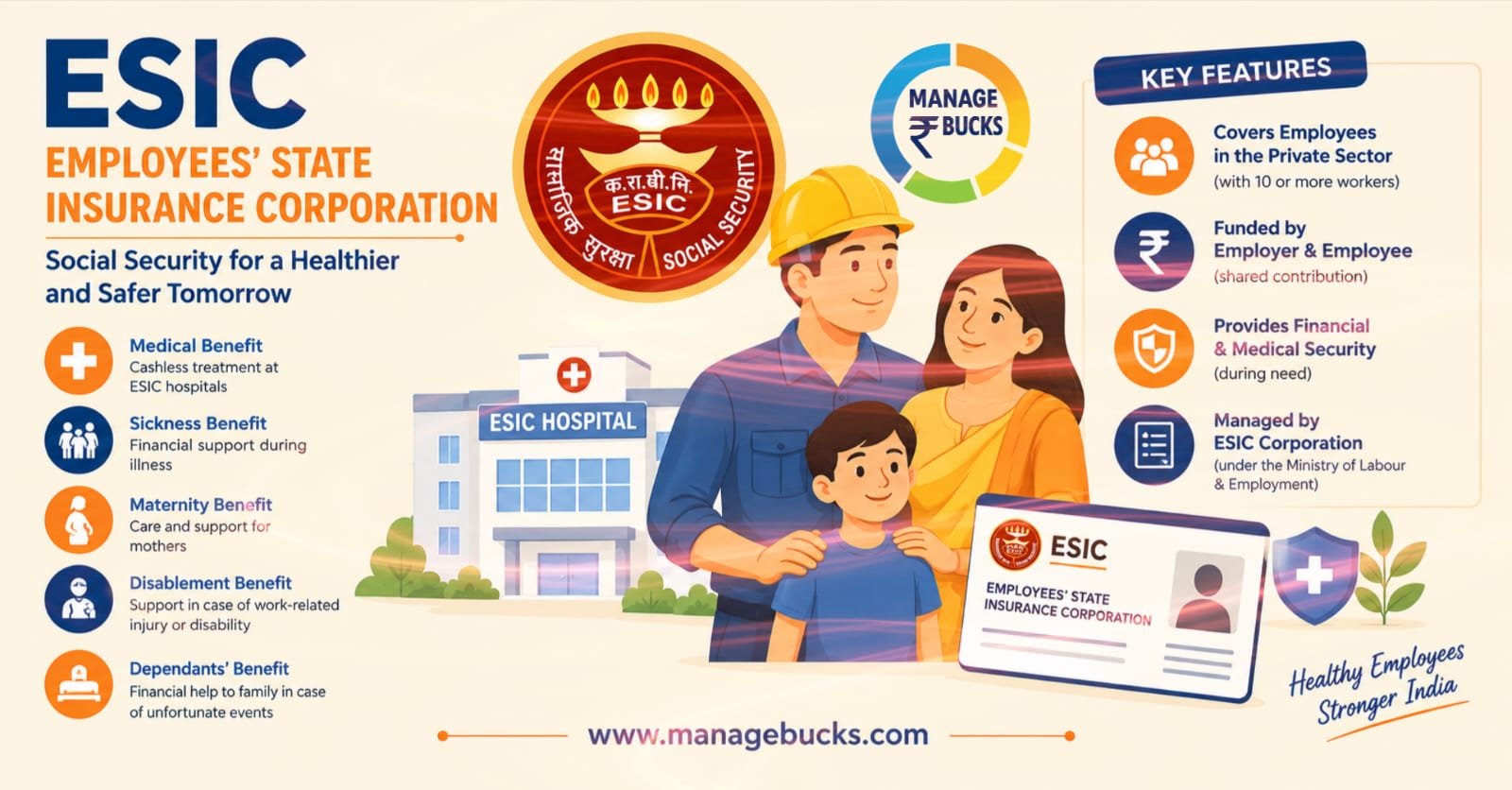
ESIC stands for ‘Employees’ State Insurance Corporation’. It is a social security scheme of the Government of India that operates under the Ministry of Labour and Employment and functions in accordance with the ESI Act, 1948.
Simply put, ESI is a government-backed insurance scheme for employees working in various establishments—such as factories, shops, hotels, restaurants, cinemas, and certain educational or medical institutions—provided they fall within the scope of the applicable coverage rules. Every month, a small portion of your salary and a larger contribution from your employer are deposited into this fund. In return, you and your dependent family members receive medical facilities, cash benefits during illness or maternity and financial assistance in the event of disability or death caused by work-related injuries.
Who is eligible for ESIC?
There are certain conditions for being covered under the ESIC scheme; not every employee automatically falls within its ambit. Both your salary and the type of establishment where you work are determining factors:
For employees: Under current rules, employees earning a gross monthly wage of up to ₹21,000 are covered by this scheme. For persons with disabilities, this limit is higher, set at ₹25,000 per month. However, there has been ongoing discussion about raising this limit—so if you are reading this in the future, be sure to check the official ESIC website for the latest information.
For Employers: ESIC generally applies to non-seasonal factories and establishments employing 10 or more people (this threshold may vary by state; for instance, the limit is 20 in states like Maharashtra, Tamil Nadu, and Odisha). It covers factories, shops, hotels, restaurants, cinemas, road transport companies, educational institutions, hospitals, and most other private-sector employers, subject to state notifications.
Contribution Rates and How Much Is Deducted?
The total contribution amounts to 4% of the gross wage, shared between the employer and the employee. The current rates are:
Employer’s share: 3.25%
Employee’s share: 0.75%
There is also a small relief provision: if your average daily wage is ₹176 or less, you are not required to pay your share at all, although your employer will continue to make their contribution.
So, for example, on a monthly salary of ₹16,000, you would contribute approximately ₹16000 X 0.75% = ₹120, while your employer would contribute ₹16000 X 3.25% = 520. Total going into the fund is ₹640 per month.
What are the benefits of ESIC?
Under this scheme, employees receive various benefits, such as the following:
1. Medical Benefits
As an insured employee, you and your family are entitled to free medical treatment at ESIC-affiliated hospitals and dispensaries. Even after retiring or leaving your job—provided you have made contributions for a specified period—you can continue to avail of medical benefits for yourself and your spouse by paying a nominal annual fee.
2. Sickness Benefit
If you are unable to work due to a certified illness, ESIC provides a cash benefit—amounting to approximately 70% of your average daily earnings; the exact amount and duration depend on the applicable ESIC rules and the nature of the illness.
3. Maternity Benefit
Insured female employees are entitled to paid leave for childbirth, miscarriage, or related medical conditions; this benefit currently extends up to 26 weeks and provides approximately the full average daily wage. Medical facilities are also available before and after delivery.
4. Disablement Benefit
If an employee sustains an injury at work that results in temporary or permanent disability, ESIC may provide disability-related benefits based on applicable conditions.
5. Dependants Benefit
If an employee dies due to a work-related injury or a workplace hazard, their dependent family members receive a monthly pension.
6. Funeral Expenses
In the event of an employee’s death, the family is provided with funds to cover funeral expenses. The amount and conditions for this will be in accordance with the prevailing ESIC rules.
7. Other Expenses
Under ESIC, there are provisions for unemployment-related assistance schemes based on specific eligibility criteria. Official ESIC information lists these benefits and schemes, which include unemployment allowance, vocational rehabilitation, physical rehabilitation, skill-upgradation training, and other forms of assistance.
How to Claim ESIC Benefits?
The claim process to avail the benefits is very simple. Here is a step-by-step guide:
Step 1: Check your registration
First, ensure that you are registered under ESIC and possess your ESIC IP (Insured Person) number or e-Pehchan card. You can also view your ESIC details through the available ESIC services.
Step 2: Visit the ESIC medical facility
For medical treatment, visit an ESI dispensary, hospital, or any other authorized facility based on your eligibility. Carry your e-Pehchan card or other necessary identity documents/details with you.
Step 3: Get medical examination or certification
If you wish to avail benefits related to sickness, maternity, or disability, necessary medical examinations and certificates may be required. Please visit the nearest ESIC dispensary or hospital; the doctor will examine you and issue a medical certificate.
Step 4: Submit the Claim
Fill out the prescribed form for the relevant benefit and attach the following documents with it, such as:
- ESIC Insurance Number
- e-Pehchan Card
- Aadhaar or other identification, where required
- Medical certificate
- Bank account details
- Employment or wage details
- Accident/employment injury documents, where applicable
- Other documents prescribed for the particular claim
The exact documents can vary depending on the benefit.
Step 5: Track the Claim
After submitting the necessary information, you should keep a record of your claim/reference details and check the status through the relevant ESIC channel. You can check the claim status via the Umang App or by logging into the ESIC Portal.
Frequently Asked Questions (FAQs)
Is ESIC compulsory?
Yes, if your establishment is covered under the ESIC Act, it is legally mandatory for the employer to register the employees.
Can my family use ESIC benefits?
Yes. Eligible family members of an insured person can receive medical benefits under the ESI Scheme, subject to the applicable rules.
What is an ESIC IP (Insured Person) Number?
When an employee is registered under ESIC, they receive a unique Insurance Number.
What is the ESIC e-Pehchan Card?
The e-Pehchan Card contains the insured person’s ESIC insurance details.
What to do if Card is lost?
You can download a duplicate identity card by logging into the online portal or contact the nearest ESIC office.
How long does it take for an ESIC claim to be processed?
There’s no fixed universal timeline — it depends on the branch office and completeness of documentation but generally, the claim is processed within 15–30 days, and the amount is credited to your bank account.
Can I get ESIC medical benefits after retirement?
Yes, under a separate scheme for retired and permanently disabled insured persons, you and your spouse can continue receiving medical benefits after retirement
Conclusion
ESIC is a highly beneficial social security scheme that provides health and financial security to employees and their families. If you are eligible, you should certainly avail the benefits of this scheme.
This article is for general information purposes. Rules regarding salary ceilings and contribution rates are determined by the government and are subject to change; therefore, always verify the current figures on the official ESIC website (esic.gov.in).