If you are considering getting term insurance—or if you are confused about what it actually is, why everyone recommends it, or whether you even need it—then this guide is for you. In this guide, we will explain everything you need to know about term insurance in simple language.
What is Term Insurance?
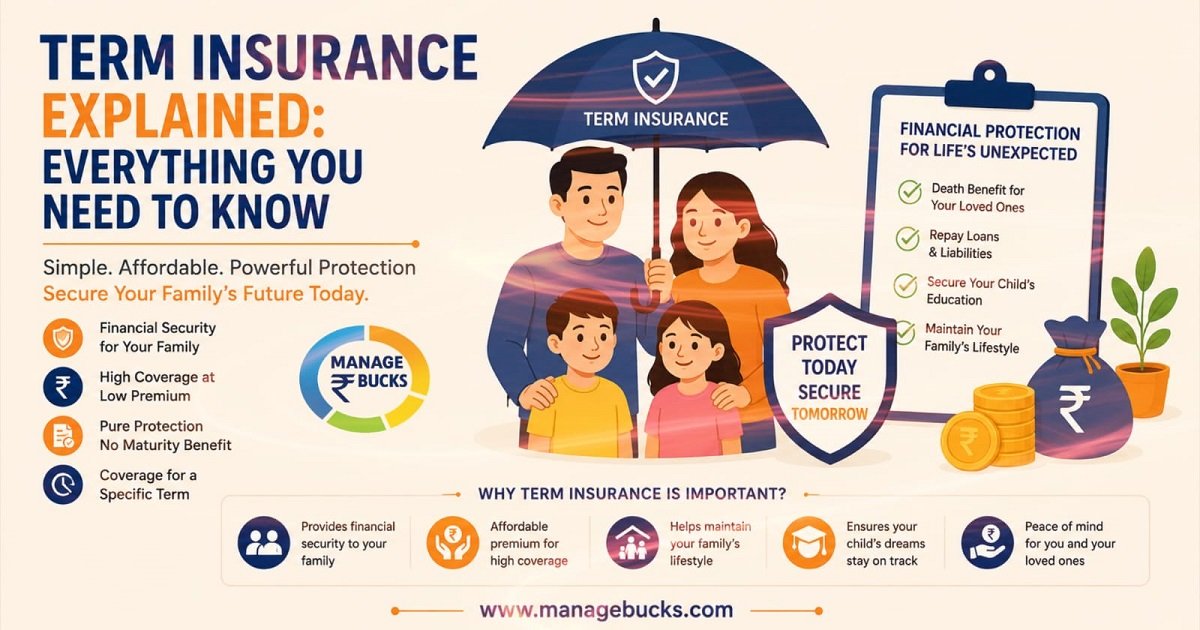
Term insurance is a type of life insurance where you pay a small annual amount (known as the premium), and in return, the insurance company promises to pay a large lump sum (known as the sum assured) to your family if something happens to you during the policy term.
This is not an investment plan or one that offers maturity benefits; it is taken to secure your family’s future. Its purpose is to provide financial support to meet your family’s needs in the event of your death.
Basic term plans do not offer maturity benefits—meaning if you survive the policy term, you do not get any money back. This is why the premiums for these plans are much lower compared to other insurance plans.
Example
Suppose Amit buys a term insurance plan with:
- Sum Assured: ₹1 Crore
- Policy Term: 30 Years
- Annual Premium: ₹12,000
If Amit dies during these 30 years, his family receives ₹1 Crore.
If Amit survives the full 30 years, the policy ends, and no amount is paid.
Why is term insurance important?
Term insurance secures your family’s financial future. It helps your family with the following:
- Meeting household expenses
- Covering children’s education costs
- Achieving future financial goals
- Maintaining their standard of living
Without life insurance, your family could face financial difficulties after your death.
How Does Term Insurance Work?
You can easily understand how it works through these simple steps:
- You choose a sum assured—the amount your family would receive if something were to happen to you (for example – ₹1 crore).
- You choose a policy term—the duration for which you want coverage (for example – until you turn 60).
- You pay a premium—annually, monthly, or as a lump sum.
- If you pass away during the policy term, the insurer pays the sum assured to your nominee (usually your spouse, parents, or children).
- If you survive beyond the policy term, the policy simply expires—unless you opted for a “Return of Premium” plan, which refunds the premiums you paid.
Types of Term Insurance Plans
Here are some common types:
- Level Term Plan – The ‘Sum Assured’ (insurance amount) remains constant throughout the policy term. This is the most common and affordable type.
- Increasing Term Plan – The coverage amount increases over time, helping you cope with inflation or growing responsibilities.
- Decreasing Term Plan – The coverage decreases over time; it is often used to align the coverage with a reducing loan balance (such as a home loan).
- Term Plan with Return of Premium (TROP) – If you survive the policy term, all the premiums you paid are refunded to you. This type costs more than a regular term plan.
What are Riders (Add-On) in term insurance?
Riders are optional benefits that you can add by paying an additional premium. Some common riders include:
- Critical Illness Rider – This rider provides a payout if you are diagnosed with a critical illness covered under the policy.
- Accidental Death Benefit Rider – This provides an additional sum in the event of death due to an accident.
- Accidental Disability Rider – This offers financial assistance in accordance with the policy terms if an accident results in permanent disability.
- Waiver of Premium Rider – Future premiums may be waived if certain specified events occur.
Key Benefits of Term Insurance
- High coverage at low cost – You can secure a large sum assured (e.g., ₹1 crore) for a low premium, especially if purchased at a younger age.
- Financial security – Your family can use the payout for daily expenses, loan repayments, children’s education, or maintaining their lifestyle.
- Tax benefits – Premiums paid qualify for tax deductions under Section 80C, and the payout received by your nominee is generally tax-free under Section 10(10D).
- Optional riders – You can add extra protection—such as critical illness cover, accidental death benefits, or disability cover—for a nominal additional premium.
- Flexibility – You can choose the policy term, premium payment frequency, and payout method (lump sum, monthly income, or a combination of both) based on your needs.
How much cover do you need?
A common recommendation is to opt for a cover that is 10 to 20 times your annual income, while also considering the following factors:
- Outstanding loans
- Monthly household expenses
- Children’s education
- Future financial goals
- Existing savings and investments
Example:
Annual income = ₹10 lakh
Suggested cover = ₹1 crore to ₹2 crore (depending on your financial responsibilities and goals).
Required Documents
Generally, you will need the following:
- PAN card
- Aadhaar card
- Passport-sized photograph
- Proof of income
- Proof of address
- Proof of age
- Bank details
- Medical report (if required)
The specific documents required may vary depending on the insurance company.
Eligibility and Rules
- Age – Most insurance companies offer term plans to individuals aged 18 to 65, though this may vary.
- Proof of Income – You will generally need to submit income-related documents, especially if the ‘Sum Assured’ (insurance amount) is high.
- Medical Test – Depending on your age and the coverage amount, you may be required to undergo a medical check-up.
- Advice on ‘Sum Assured’ – A general rule is to have coverage equal to at least 10–15 times your annual income; this can be adjusted based on your liabilities and dependents.
- Nominee Details – You must clearly specify the name of the nominee who will receive the payout.
How to Choose the Best Term Insurance Plan
- Compare premiums – Do not simply choose the cheapest policy.
- Check the claim settlement record – Select an insurance company with a strong claim settlement record and excellent customer service.
- Choose the right coverage – Do not opt for insufficient life cover.
- Read the policy exclusions – Understand the situations under which a claim will not be paid.
- Select relevant riders – Choose only those riders that align with your specific needs.
Common Reasons for Claim Rejection
Claims may be delayed or rejected due to the following reasons:
- Incorrect information in the application
- Withholding medical history
- Failure to disclose smoking or alcohol consumption habits
- Policy lapse due to non-payment of premiums
- Fraudulent documents
Tips Before You Buy Term Insurance
- Buy early – Premiums are significantly lower when you are young and in good health.
- Be completely honest – Provide accurate information about your health, habits, and lifestyle to avoid claim rejection later.
- Avoid under-insuring or over-insuring – Choose a cover that truly aligns with your family’s needs.
- Compare plans online – Use insurance company websites or reliable comparison platforms to compare features, not just premiums.
- Review your cover periodically – Consider increasing your coverage as your income and responsibilities grow (e.g., marriage, children, home loan).
How the claim process works
In the event of an unfortunate incident, your nominee will generally need to take the following steps:
- Inform the insurer about the policyholder’s death as soon as possible.
- Submit the necessary documents—these typically include the death certificate, policy documents, proof of identity, and the claim form.
- Verification by the insurer—the company reviews the documents and may request additional information.
- Claim settlement—once approved, the payment is transferred to the nominee’s bank account.
Frequently Asked Questions (FAQs)
Can I buy term insurance online?
Yes. Most insurance companies allow you to compare plans and purchase policies online.
Can I hold more than one term insurance policy?
Yes. You can purchase multiple term insurance policies, provided you meet the insurance company’s eligibility criteria.
What happens if I stop paying premiums?
If you stop paying premiums and the policy lapses, the life cover may cease, depending on the terms and conditions of the policy.
Is a medical test mandatory?
Not always. It depends on factors such as your age, health, lifestyle, and the chosen coverage amount.
Is the payout from term insurance taxable?
Generally, under Section 10(10D) of the Income Tax Act, the amount received by your nominee is tax-free, subject to certain conditions.